


Buried in the Details: Shawshank, Revisited
- noursafeialdin
- May 2, 2025
- 4 min read


Now and then, I almost forget how much I love The Shawshank Redemption. I mean, I KNOW I love it. I KNOW it’s one of the greatest films ever made. But sometimes, I think I take its greatness for granted. The thing is, The Shawshank Redemption doesn’t ask for attention, it earns it. Quietly, patiently. It gets under my skin. Every time I revisit it, I feel like I have discovered a new corner of Shawshank prison that I hadn’t seen before.
Watching this film isn’t just watching a story unfold; it’s sitting with it, letting it settle into your bones. It doesn't scream. It just... stays.
Film Details
Title: The Shawshank Redemption (1994)
Director: Frank Darabont
Writer: Frank Darabont / Stephen King
Starring: Tim Robbins, Morgan Freeman, Bob Gunton
Genre: Drama
Runtime: 2h 22m
Rating: R (Strong language and prison violence)
“Everyone in here is innocent.”
The film starts with a strong premise: Andy Dufresne (Tim Robbins), a quiet and composed banker, is convicted of murdering his wife and her lover. Despite his claims that he’s innocent, he’s sentenced to two consecutive life terms at Shawshank State Penitentiary.
At Shawshank, time moves differently. Days bleed into each other. Men grow old. Hope fades. Andy finds his place among the inmates, making a circle of quiet but loyal friendships, most notably with “Red” (Morgan Freeman), a man who landed in Shawshank when he was just a 20-year-old “kid,” and never left. Over the years, Shawshank became his whole world.
The Shawshank Redemption follows Andy’s journey through those long years in prison, and how, despite the coldness of Shawshank’s walls, he finds something warmer, something stronger, a faint glow of light at the end of the tunnel.

This thing, called “Hope”
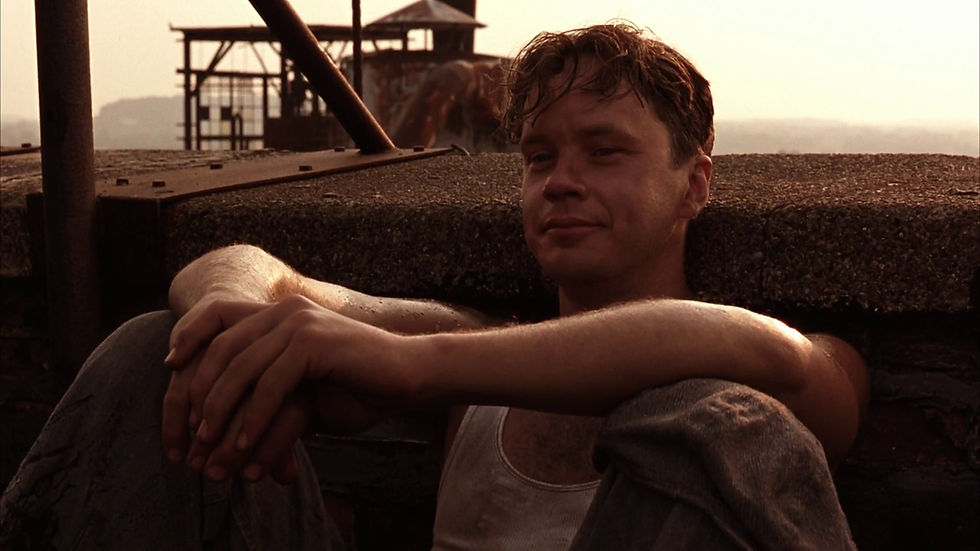
The Shawshank Redemption is more than just a prison movie, it’s a heated debate about the "validity" of hope. For the average person, hope is just that…hope. A sweet, dreamy feeling that something better is always on the horizon. But for someone stuck between the walls of Shawshank, for people living in the harshest of realities, hope is a delicate, almost dangerous thing. It's not something that’s easily grasped or fully understood. Instead, hope in Shawshank takes on different forms, depending on who you ask.
This is where the heart of the film beats strongest. Through the incredible performances of Tim Robbins and Morgan Freeman, we witness the nuanced debate on what hope truly means. Each has his proper definition of hope, and we keep unraveling their viewpoint as the story unfolds. Yet, despite their differences, these two characters learn from each other. Their dynamic emphasizes one of the film’s biggest questions: what is hope? A concept? A choice? A question of survival, or of faith?

And as much as we grow attached to the inmates, the film never lets us forget about the power structures they’re trapped under. Bob Gunton’s Warden Norton is the kind of quiet evil that feels more terrifying than the loud kind. Through his cold, calculated authority, we see how control and hopelessness can be wielded like weapons. His presence adds layers to the central question we’re watching unfold: what happens to hope in a place designed to kill it?
Crafting a timeless masterpiece
What sets The Shawshank Redemption apart isn’t just what’s said; it’s everything that isn’t. The technical side of the film feels almost invisible, like it’s hiding in plain sight. But maybe that’s exactly what makes it so powerful. Every frame, every cut, every sound is deliberately quiet. The film’s strength lies in its silence.
The cinematography doesn’t rely on grandeur or sweeping landscapes, and that’s exactly what this story needs. The cinematography lets the stillness speak. The camera lingers just long enough for you to feel the weight of isolation, the dull ache of routine, the slow crawl of time behind bars. You don’t just see Shawshank, you begin to sense it. Its loneliness, its obscurity, its haunting rhythm.

The costume design and makeup are quiet narrators. The story stretches across nearly two decades, and you can feel every one of them. The greying of hair, the deepening of lines, the subtle wear of prison uniforms, they all reflect the slow erosion of time on the inside, contrasted with the fast, unforgiving pace of life beyond the walls. And yet, Shawshank itself remains unchanged. Static. Timeless. Almost like a character frozen in place, mirroring Red’s words:
“They send you here for life, and that's exactly what they take. The part that counts, anyway.”
And the cherry on top, the screenplay. Frank Darabont adapted Stephen King’s novella Rita Hayworth and Shawshank Redemption into a delicate dialogue that keeps you hooked throughout the movie.
The narration? Oh man, THE NARRATION. That voiceover could’ve easily been overdone, too explanatory, or cheesy. But it’s not. Morgan Freeman’s delivery plus the screenplay’s restraint creates something that feels more like poetry than a plot device. It’s like the story is being told to you by someone who’s lived it and survived it.
Masterpiece in all degrees
It’s almost ironic that The Shawshank Redemption didn’t make a splash when it was first released. It wasn’t a box office hit. It didn’t win Best Picture. It didn’t have the loud fanfare or the fast rise. And maybe that’s exactly why it endured.
Despite being released almost 30 years ago, this film kept slowly finding its way into people’s lives. Through VHS tapes. Through word of mouth. And in that quiet journey, it became something immortal. It’s now consistently ranked as one of the greatest films of all time. But its legacy wasn’t built on hype. It was built on craft. On the delicate balance between sorrow and serenity. On the belief that, somehow, hope can crawl through the darkest tunnels and still come out clean.
What makes The Shawshank Redemption so lasting isn’t just its story. It’s how it’s told. With precision. With empathy. With a kind of stillness that most films are too afraid to sit in.
And maybe that’s the point.
In a world obsessed with spectacle, Shawshank whispers.
And we still hear it.


Comments